Views: 0 Author: Site Editor Publish Time: 2025-10-22 Origin: Site


Geotextiles are crucial for construction, erosion control, and disaster prevention. These versatile materials improve soil stability and drainage. But how are they made?In this article, we will explore the key aspects of geotextile production, the materials involved, and the various manufacturing methods used to create these essential fabrics.
Geotextiles are permeable fabrics made from synthetic or natural fibers. They are primarily used to separate, reinforce, filter, and drain soil. In construction, geotextiles are crucial for stabilizing soil, improving drainage systems, and preventing erosion. Their use is widespread in infrastructure projects like roads, dams, and retaining walls, where they serve as a foundation for more durable construction.
Geotextiles are employed in numerous applications:
| Road Construction | They are used to stabilize the ground, prevent soil erosion, and improve the longevity of roadways. |
| Erosion Control | In coastal areas and riverbanks, geotextiles help control soil erosion, preserving landscapes and protecting infrastructure. |
| Disaster Prevention | Geotextiles are used in flood-prone areas to protect against soil degradation and manage water flow effectively. |
Understanding how geotextiles are produced is crucial for engineers and construction managers. The production method directly influences the material’s durability, tensile strength, and suitability for specific tasks such as drainage, filtration, and soil separation. The right manufacturing process ensures geotextiles perform optimally in their intended application, whether for road construction or erosion control.
Geotextiles can be made from natural fibers like jute, coir, and hemp, or synthetic fibers such as polypropylene, polyester, and polyethylene. Natural fibers are often biodegradable and suitable for temporary applications, such as soil erosion control during the early stages of vegetation growth. On the other hand, synthetic fibers offer higher durability and strength, making them ideal for long-term use in roads and other infrastructure projects.
The choice of raw material impacts several important properties:
Polyester and Polypropylene: These synthetic fibers are widely used in geotextile production due to their resistance to UV radiation, high tensile strength, and excellent creep resistance.
Natural Fibers: Materials like jute and coir are biodegradable and cost-effective, making them suitable for temporary applications. However, they have lower strength compared to synthetic fibers and degrade faster under environmental conditions.
The material selected for geotextile production determines its performance characteristics, such as:
Tensile Strength: Essential for supporting the weight of construction materials, such as soil and aggregates.
Filtration Efficiency: Some materials provide better water permeability, making them ideal for drainage applications.
UV and Temperature Resistance: Synthetic fibers like polypropylene offer better resistance to UV degradation and high temperatures, enhancing their longevity in harsh environments.
Woven geotextiles are the most common type of geotextiles, made by interlacing two sets of yarns—warp and weft—on a loom. This process creates a fabric with strong mechanical properties, ideal for applications where high tensile strength is required. Woven geotextiles are widely used in road construction and land reinforcement projects.
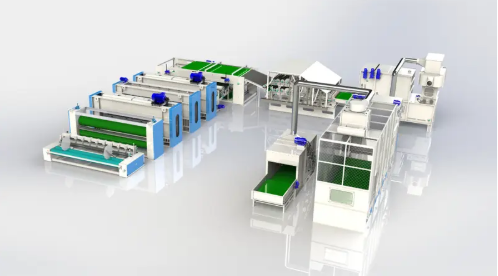
Non-woven geotextiles are made by bonding fibers through thermal, chemical, or mechanical processes. Needle-punching is the most common method, where barbed needles entangle fibers to form a fabric. This type of geotextile is used in drainage, filtration, and soil separation applications. It offers higher permeability compared to woven types and is less prone to tear, making it ideal for erosion control.
Knitted geotextiles are produced by intertwining yarns in a looped structure. This process results in a fabric that is lighter and more flexible than woven or non-woven geotextiles. While not as widely used, knitted geotextiles are gaining popularity due to their ease of handling and lower transportation costs. They are used in applications where weight reduction is essential.
The production of geotextiles begins with the creation of filaments, which are made by extruding molten polymer through a spinneret. The polymer is then drawn to align the molecular structure, giving the filament high tensile strength and durability. These filaments are then woven, needle-punched, or knitted to create the final geotextile fabric.
In some cases, staple fibers—short lengths of filaments—are used in the production of geotextiles. These fibers are spun into yarns and then woven or needle-punched into fabric. Slit films, made by slicing thin films of polymer, are also used in geotextile manufacturing. These materials are fibrillated, or broken into smaller strands, which are then processed into geotextiles.
After the filaments are produced, they are processed through warping and weaving machines. Warping involves arranging the filaments in parallel order on a beam, while weaving interlaces them into a fabric. Different types of looms, such as projectile and rapier looms, are used to produce geotextiles with varying densities and structures depending on the intended use.
Geotextiles designed for drainage and filtration are optimized to allow water to pass through while preventing the passage of soil particles. These geotextiles are made from materials with high permeability, ensuring efficient water flow and soil separation. They are commonly used in road construction, drainage systems, and agricultural applications.
Erosion control geotextiles are specifically engineered to prevent soil erosion in areas with heavy rainfall or strong winds. They are designed to withstand harsh environmental conditions while reinforcing the soil structure. These geotextiles are often used in coastal areas, riverbanks, and embankments to reduce erosion and stabilize the soil.
Geotextiles are used in road construction to enhance the strength and durability of road bases. They help distribute loads evenly and prevent soil degradation, ensuring the longevity of the roadway. In temporary road construction, geotextiles provide a quick and cost-effective solution to stabilize the ground and support the weight of construction vehicles.
Advances in nanotechnology have led to the integration of sensors into geotextiles. These sensors can monitor environmental conditions, such as moisture levels, temperature, and soil movement, providing valuable data for infrastructure projects. In disaster-prone areas, geotextiles embedded with sensors can detect changes in soil conditions, helping to prevent catastrophic failures like landslides and floods.
The demand for sustainable infrastructure solutions has spurred the development of biodegradable geotextiles. Made from natural fibers or biodegradable synthetic materials, these geotextiles are ideal for temporary applications where environmental impact is a concern. As climate change accelerates, biodegradable geotextiles offer a solution to reduce the long-term ecological footprint of construction projects.
Geotextiles are essential materials in modern civil engineering, providing numerous benefits for infrastructure projects. Understanding geotextile production, from raw materials to manufacturing techniques, is key for selecting the right geotextile. With advancements in nanotechnology and biodegradable options, geotextiles are poised to play a significant role in sustainable construction and disaster prevention. Companies like Weicheng offer innovative geotextile solutions, delivering high-performance products that meet diverse construction needs while ensuring long-term durability.
A: Geotextiles are permeable fabrics used in civil engineering for filtration, drainage, reinforcement, and separation. They play a critical role in improving soil stability and preventing erosion in construction projects.
A: Geotextile production involves manufacturing techniques such as weaving, needle-punching, or chemical bonding of synthetic or natural fibers to create durable, high-performance fabrics suitable for various applications.
A: Geotextile production typically uses synthetic fibers like polypropylene and polyester, as well as natural fibers such as jute and coir. These materials determine the geotextile's strength, durability, and biodegradability.
A: The production process, including the choice of fibers and manufacturing techniques, directly affects the geotextile's tensile strength, permeability, and UV resistance, ensuring it performs optimally in various applications.
A: Understanding geotextile production helps engineers select the right geotextile for specific needs, such as road construction, erosion control, or drainage, ensuring the material’s performance and longevity.
A: Yes, biodegradable geotextiles are produced from natural fibers or biodegradable synthetic materials. They are ideal for temporary applications where environmental impact is a concern.
A: Woven geotextiles, made by interlacing yarns, provide high tensile strength and durability, making them ideal for reinforcement and soil stabilization applications.