Views: 0 Author: Site Editor Publish Time: 2026-09-29 Origin: Site


High-speed nonwoven manufacturing faces a persistent bottleneck during the fiber transfer and parallelization stages of the carding process. Plant managers and process engineers must balance throughput demands with strict quality tolerances, specifically targeting MD/CD strength ratios and nep reduction. Under-specifying the carding configuration leads to fiber damage and web defects. Over-specifying results in unnecessary equipment footprint and excessive maintenance downtime. This evaluation compares standard single doffer configurations against double cylinder double doffer carding. We analyze mechanical differences, fiber compatibility, and operational requirements to determine the optimal architecture for specific nonwoven applications. You will see exactly how mechanical extraction limits dictate line speed and why specific fiber blends demand progressive opening stages.
Web Uniformity: Double cylinder double doffer configurations provide superior progressive fiber opening and blending, significantly reducing neps and improving web evenness compared to single doffer systems.
Throughput Capacity: The dual-doffer extraction allows for higher cylinder speeds and heavier web weights without overwhelming the card clothing, maximizing overall line speed and strength stability.
Application Specificity: Single doffer machines remain viable for basic, lightweight webs and coarse fibers, whereas double cylinder double doffer architectures are critical for fine denier, technical textiles, and high-GSM applications.
Hybrid Alternatives: Single cylinder double doffer machines offer a middle-ground solution, providing better throughput than a baseline single doffer without the full footprint and CapEx of a dual-cylinder system.
Operational Trade-offs: The increased production capabilities of a double cylinder double doffer carding machine require a larger facility footprint, heavy-duty frames, higher initial CapEx, and more rigorous maintenance protocols for card clothing and speed synchronization.
Table of Contents
The single-cylinder single-doffer system uses one main cylinder with worker and stripper rolls to open, comb, and align fibers before a single doffer removes the web. Its main limitation is the restricted fiber transfer capacity of the doffer, which causes cylinder loading, fiber recirculation, and nep formation when throughput is pushed too high. This configuration is suitable for lower-weight webs (typically 15–40 GSM) and applications where extreme opening and blending performance are not required, such as standard hygiene products and coarse fiber processing.
The single-cylinder double-doffer system improves throughput by adding a second doffer to share the fiber extraction workload from the main cylinder. This reduces cylinder loading, minimizes fiber recirculation, and improves web stability without requiring the space and complexity of a second cylinder. It is a practical upgrade option for factories that need higher output but have limited floor space, offering better production capacity and fiber control compared with a single-doffer design.
Advanced nonwoven production requires a more aggressive, yet controlled, approach to fiber opening. This is where double cylinder double doffer carding excels. This architecture utilizes a progressive fiber mass conversion process. The machine features a breast cylinder, or pre-cylinder, positioned immediately after the feed section and before the main cylinder. The breast cylinder handles the initial opening of raw, clumped materials. It performs the coarse carding work using heavier, more robust metallic wire. The fiber then transfers via a transfer roll to the main cylinder for fine, intensive carding.
The mechanical advantage of the double doffer system becomes apparent at the output stage. Upper and lower doffers work in tandem to strip fibers from the main cylinder continuously. This effectively doubles the transfer capacity and completely prevents cylinder loading, even at extreme production speeds exceeding 150 meters per minute. Speed differentials play a crucial role here. The substantially lower speed of the doffers relative to the main cylinder facilitates optimal fiber condensation, creating a dense, highly cohesive web capable of withstanding downstream drafting.
Implementing this architecture demands specific structural necessities. The machine requires a robust, heavy-duty cast iron or reinforced steel frame. This frame must support the massive weight of dual cylinders, which can exceed several tons each. It must also absorb the dynamic loads and high-frequency vibrations generated by high-speed operation. Precision engineering ensures the exact gauge distances between the cylinders, worker rolls, and doffers remain constant during production. Even a 0.05mm deviation in gauge settings can result in catastrophic web defects or metal-to-metal contact.
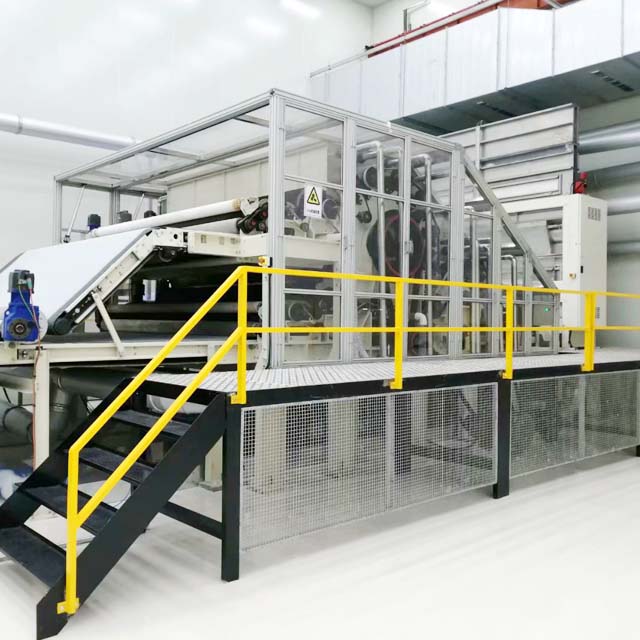
Web strength heavily depends on fiber orientation. Machine Direction (MD) refers to fibers aligned parallel to the flow of the machine. Cross Direction (CD) refers to fibers aligned perpendicular to the flow. Single doffer machines naturally produce webs with high MD strength and low CD strength. The mechanical drafting action pulls the fibers, aligning them rigidly along the machine's axis. This results in a web that tears easily when pulled from the sides.
Double cylinder double doffer carding fundamentally alters this dynamic. The dual extraction points disrupt strict parallel alignment. When equipped with double randomizers, this effect amplifies significantly. Randomizers are specialized rollers covered in aggressive wire that work in conjunction with the dual-doffer output to scramble fiber orientation. They aggressively randomize the web layer before it reaches the crosslapper or bonding stage. This creates a highly isotropic web. Isotropic webs boast balanced MD/CD tensile strength ratios, often approaching 1:1 or 1.5:1. This balance is critical for applications requiring multi-directional durability, such as geotextiles, roofing substrates, and medical gowns.
Configuration | Typical MD/CD Ratio | Throughput Limit (kg/h/m) | Web Uniformity Profile |
|---|---|---|---|
Single Cylinder / Single Doffer | 4:1 to 6:1 | 150 - 250 | Standard (High MD bias, prone to drafting) |
Single Cylinder / Double Doffer | 3:1 to 4:1 | 250 - 400 | Improved (Better MD/CD balance, stable edges) |
Double Cylinder / Double Doffer | 1.5:1 to 2.5:1 | 400 - 800+ | Premium (Highly isotropic, excellent visual density) |
Throughput determines the production output of a nonwoven line and is measured in kg/h/m of working width. Single-doffer systems have limited capacity because the doffer may not remove fiber fast enough at high feed rates, causing cylinder loading, web defects, and machine stoppages. Dual-doffer systems increase extraction capacity, allowing higher feed rates and cylinder speeds while maintaining web quality. This design significantly improves maximum output and can greatly increase production capacity for the same fiber blend.
Dual-cylinder systems provide more working points through additional worker and stripper rolls, creating a longer and more effective fiber-opening process. The progressive carding action improves fiber individualization, reduces neps, and enhances blending uniformity. This is especially important for multi-component blends, where extended mechanical interaction helps distribute different fibers, colors, and deniers evenly across the web.
Fiber type strongly affects carding performance. Coarse fibers can tolerate stronger mechanical action, while fine denier fibers require gentler processing to avoid static buildup, fiber breakage, and wire loading. Dual-cylinder systems improve fine fiber processing by using staged opening and multiple doffers, reducing damage while maintaining staple length and web quality. This makes them suitable for applications such as filtration media, hygiene materials, and high-performance synthetic substrates.
The nonwovens industry increasingly relies on recycled and technical fibers to meet sustainability goals and performance specifications. Materials like recycled PET, aramid, and carbon fibers present unique processing challenges. Recycled PET often contains melted clumps, unopened tufts, or highly inconsistent staple lengths. Aramid and carbon fibers are incredibly rigid and brittle. They resist bending and parallelization, often shattering if processed too aggressively.
A standard single doffer machine cannot process these materials efficiently. The rigid fibers damage the standard card clothing or simply pass through the machine unopened, resulting in a defective web. You must utilize the intensive carding action of a Double Cylinder Double Doffer Carding Machine for these applications. The dual-cylinder architecture applies the necessary mechanical force to break down recycled clumps in the breast cylinder section. It then forces rigid technical fibers into a uniform web in the main cylinder section. This intensive, two-stage processing is mandatory to meet the high-strength requirements of geotextiles, automotive acoustic insulation, and industrial filtration media.
High-output carding systems require more installation space, especially double-cylinder or double-doffer configurations. Although they occupy a larger footprint, they deliver higher throughput, better fiber opening, and improved web uniformity. The increased production capacity and reduced scrap often compensate for the additional floor space, making larger systems more efficient for high-volume manufacturing.
Larger carding machines require stronger foundations and upgraded auxiliary systems. Facilities must evaluate floor loading, suction capacity, fly waste control, and filtration performance before installation. Effective air management and fiber recovery systems are essential to maintain a clean environment, stable web quality, and reliable long-term operation.
Double-cylinder systems consume more total power due to additional cylinders and working components. However, evaluating energy efficiency by kWh per kilogram of output provides a more accurate picture. Higher production rates can reduce energy cost per unit of material, making advanced configurations more economical for continuous industrial production.
Single doffer systems remain a practical choice for low-throughput, standard-quality nonwovens where capital and space are strictly limited. However, when web uniformity, progressive fiber conversion, and high-speed production dictate your operational success, double cylinder double doffer carding stands as the required standard. The mechanical advantages of split extraction and progressive opening solve the fundamental bottlenecks of high-GSM and technical textile manufacturing. To move forward with your equipment strategy, execute the following steps:
Audit your current production bottlenecks to determine if fiber transfer limitations at the doffer stage are restricting your maximum line speed.
Conduct pilot line trials with your specific fiber blend on a double cylinder setup to measure exact improvements in MD/CD ratios and nep reduction.
Measure your available facility floor space and verify that your concrete foundation can support the heavy-duty frames required for dual-cylinder machines.
Review your electrical infrastructure to ensure it can handle the increased power draw and auxiliary suction fan requirements of a high-throughput system.
A: The doffer condenses and extracts the fast-moving fibers from the main cylinder. Because it operates at a substantially lower speed than the cylinder, it gathers the parallelized fibers and forms them into a continuous, cohesive web structure for the next processing stage.
A: Fine denier fibers are delicate and prone to breakage. A double cylinder setup uses a breast cylinder to gently open the fibers before they enter the high-speed main carding zone. This progressive opening prevents fiber damage, static buildup, and cylinder wrapping.
A: A single doffer can only strip a limited amount of fiber per revolution. A double doffer system splits this workload. By extracting fiber from two points simultaneously, it prevents the main cylinder from overloading, allowing operators to safely increase the overall machine speed.
A: A double randomizer scrambles the orientation of the fibers as they exit the doffers. Instead of fibers aligning strictly in the machine direction, the randomizer creates an isotropic web. This balances the tensile strength in both the machine and cross directions.
A: Replacement cycles depend entirely on the fiber type and production volume. Processing abrasive fibers like carbon or recycled PET wears the metallic wire down rapidly. Operators must grind the wire regularly to maintain sharpness and replace the clothing when grinding is no longer effective.
A: While a single cylinder double doffer improves throughput over a baseline machine, heavy geotextiles usually require the intensive opening power of a full double cylinder machine. The pre-cylinder is necessary to break down the dense fiber clumps used in heavy industrial applications.